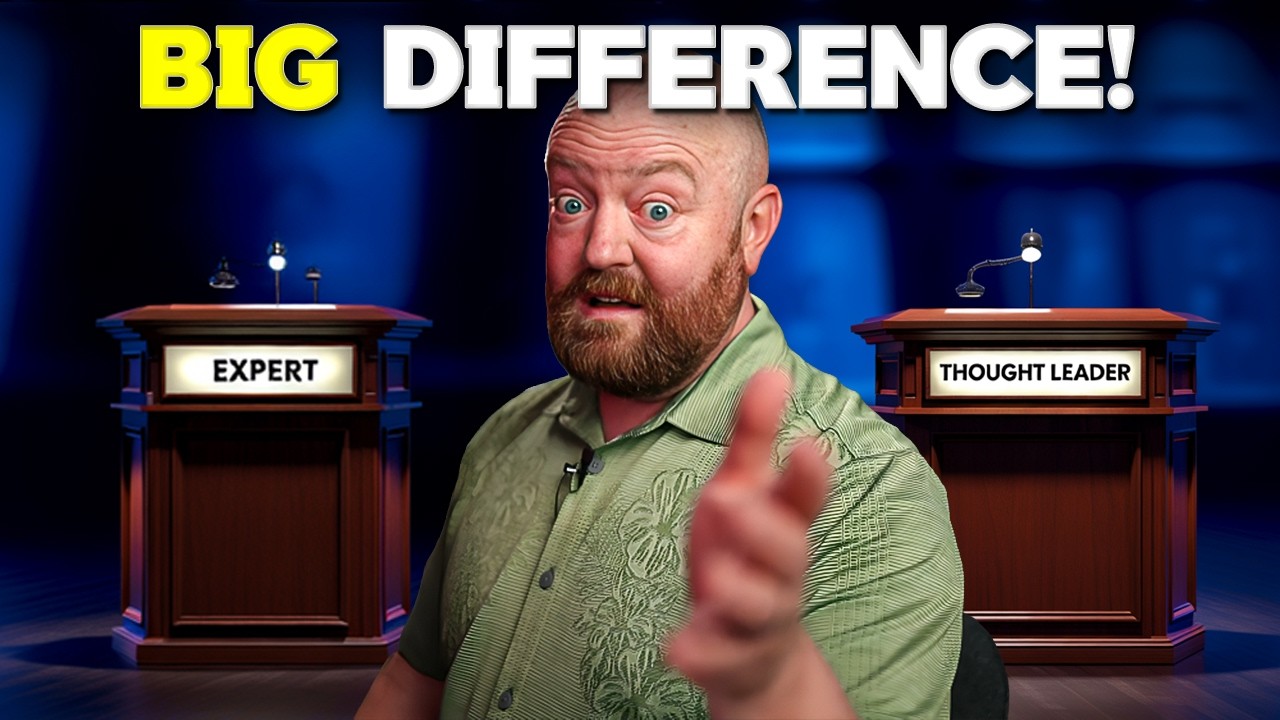
Being an expert and being a thought leader are not the same thing. You can have impressive credentials, write books, speak on hundreds of stages, build successful companies, or become a millionaire—and still not be a thought leader.
The difference comes down to one critical question: Can you consistently help other people achieve meaningful results?
The Three Levels of Expertise
A useful way to understand the difference is through the Three Levels of Expertise: knowledge, application, and transformation.
Level 1: Knowledge
Knowledge is where expertise begins. You study, train, earn credentials, and develop a deep understanding of a subject.
A professor or teacher may demonstrate an extremely high level of knowledge. They understand the concepts and can explain them clearly. But knowledge alone doesn’t prove that someone can apply those concepts successfully in the real world.
Knowledge means you understand it.
Level 2: Application
Application begins when you move from studying the subject to actually doing it.
Real-world experience introduces problems that textbooks can’t predict. You encounter obstacles, make mistakes, test solutions, adapt, fail, learn, and eventually succeed.
A Level 2 expert has gone from point A to point B and achieved the desired outcome through their own experience.
Application means you’ve done it yourself.
Level 3: Transformation
Level 3 is fundamentally different. Your focus shifts from your own success to helping other people achieve theirs.
This is harder than simply teaching what worked for you. Your clients have different strengths, weaknesses, obstacles, fears, and circumstances. Their path won’t look exactly like yours.
A Level 3 expert can guide people through those differences. They coach, consult, diagnose problems, provide feedback, adjust the strategy, and help people navigate their unique path to the desired outcome.
Over time, they develop a repeatable system that can consistently help others achieve meaningful results.
Transformation means you can help others do it too.
Why Accomplishments Don’t Automatically Make You a Thought Leader
A book, a large following, hundreds of speaking engagements, multiple successful businesses, or significant wealth can all demonstrate expertise and achievement.
But none of them, by themselves, prove thought leadership.
A book can demonstrate knowledge and experience. Speaking can demonstrate expertise and influence. Building companies can demonstrate exceptional application.
But none of these necessarily demonstrate that you can reliably transform someone else’s results.
A book can’t see where a specific person is struggling. A keynote can’t automatically adapt to someone’s unique circumstances. And your personal success doesn’t prove that you can reproduce that success through others.
Look at the Clients, Not the Bio
The strongest evidence of Level 3 expertise isn’t found in someone’s credentials. It’s found in the people they’ve helped.
Look for:
- Case studies
- Client testimonials
- Transformation stories
- Repeatable methodologies
- Measurable outcomes
There’s an important distinction between someone saying, “That was an amazing keynote,” and someone saying, “My business completely changed because of this program.”
One is inspiration. The other is transformation.
Expertise Isn’t Thought Leadership Yet
Even Level 3 expertise isn’t enough on its own.
You could be an exceptional coach, consultant, or transformation expert, but if the people who need your help can’t find you, you haven’t fully achieved thought leadership.
That’s where visibility comes in.
You need the right positioning, messaging, image, and discoverability strategy so that your ideal clients can recognize your expertise and find you when they’re searching for answers.
Thought Leadership = Expertise + Visibility
Think of the progression this way:
- Knowledge: You understand it.
- Application: You’ve done it.
- Transformation: You help others do it.
- Visibility: The people who need your help can find you.
Thought leadership isn’t the next level of expertise. It’s what happens when Level 3 expertise becomes visible.
The Real Measure of a Thought Leader
If your goal is simply to become known, Level 2 expertise may be enough. But if your goal is to build trust, change lives, and become the go-to authority in your industry, you need to go further.
You need to develop a repeatable ability to create transformation for others—and then make that expertise discoverable by the people who need it.
Ultimately, a thought leader isn’t measured by the size of their bio, follower count, or list of accomplishments.
They’re measured by the results they’ve helped other people achieve and how effectively they can be found by the people who need that transformation.